Trade knowledge, structured. Guides on HSN, exports, CHA, and trade policy - for Indian businesses.
Understand all 11 Incoterms 2020 rules, including EXW, FOB, CIF, FCA, DDP, and DAP. Learn how costs, risks, insurance, freight, and customs responsibilities are divided between buyers and sellers in international trade.
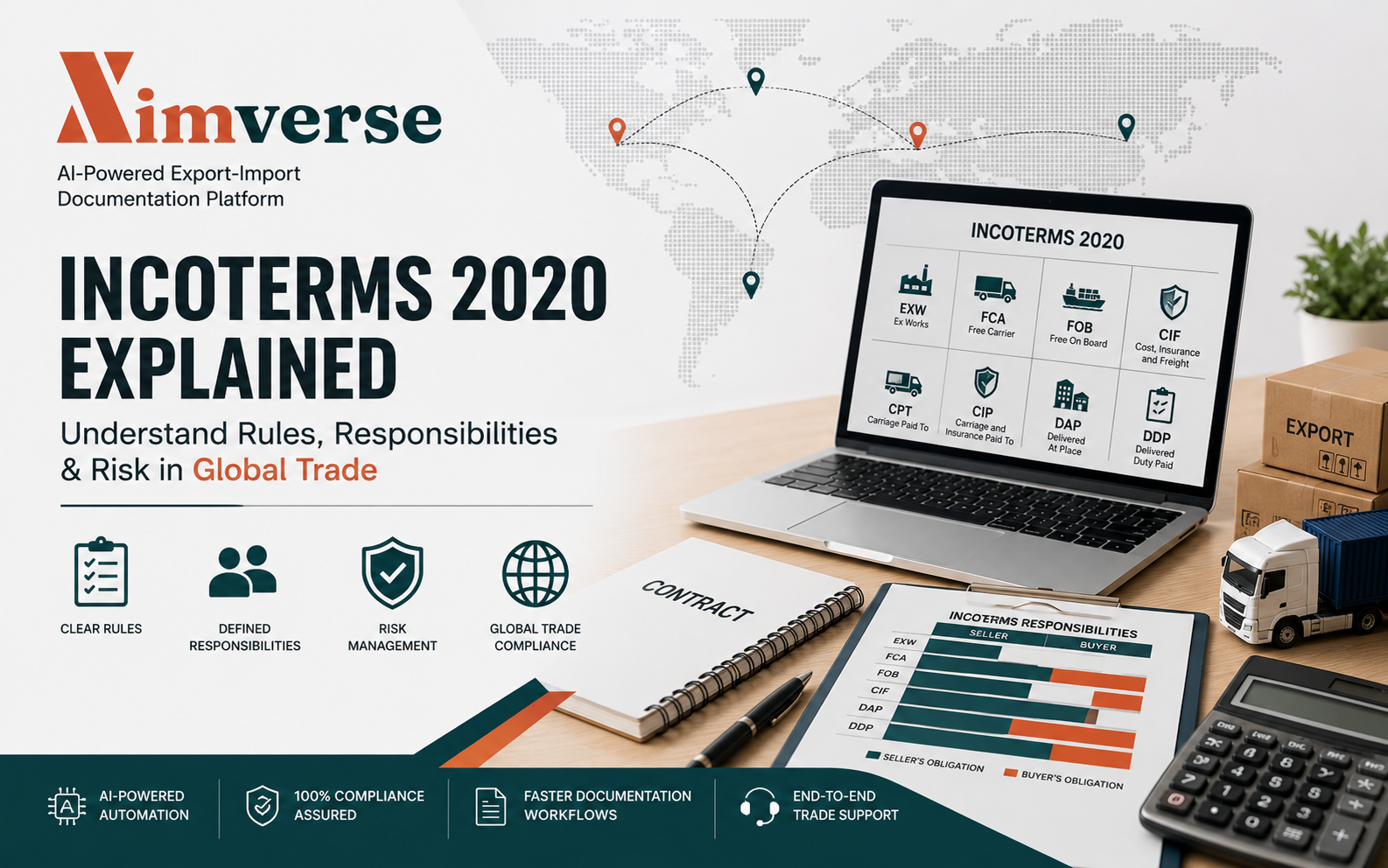
If you work with exports, imports, freight forwarding, or customs clearance, you will come across Incoterms in almost every transaction. They appear on quotations, commercial invoices, purchase orders, Letters of Credit, and shipping documents.
Choosing the wrong Incoterm creates confusion about freight costs, insurance, customs clearance, and risk transfer. By the end of this guide, you will know what each Incoterm means, when to use it, and how it affects your shipment.
Incoterms are standard trade rules published by the International Chamber of Commerce (ICC) that define the responsibilities of buyers and sellers in international trade.
An Incoterm answers four important questions:
Who arranges transportation?
Who pays freight costs?
Who arranges insurance?
When does risk transfer from seller to buyer?
Incoterms do not determine ownership of goods. They only define costs, responsibilities, and risk allocation between trading parties.
Every export contract should clearly mention the agreed Incoterm and location.
Example:
FOB Nhava Sheva, India (Incoterms 2020)
CIF Jebel Ali, UAE (Incoterms 2020)
DDP Hamburg, Germany (Incoterms 2020)
The location matters because it determines where responsibility changes hands.
Incoterms remove ambiguity from international transactions.
Without a clearly defined Incoterm, disputes often arise regarding:
Freight payments
Insurance claims
Port charges
Customs responsibilities
Cargo damage during transit
For example, an exporter may assume the buyer is paying ocean freight while the buyer expects the seller to arrange transportation. A properly defined Incoterm eliminates this confusion.
For Indian exporters, Incoterms also affect freight calculations, FOB value declarations, shipping documentation, and commercial negotiations.
These Incoterms are commonly used when the buyer wants greater control over logistics.
Under EXW, the seller has the minimum responsibility.
The seller makes the goods available at their factory, warehouse, or premises.
The buyer handles:
Pickup
Export customs clearance
Transportation
Insurance
Import clearance
Final delivery
EXW is generally used when the buyer has a strong logistics network in the exporting country.
Under FCA, the seller delivers goods to a carrier nominated by the buyer and completes export customs clearance.
The seller handles:
Packaging
Export customs clearance
Delivery to carrier
The buyer handles:
Main freight
Insurance
Import clearance
For container shipments, FCA is generally preferred over FOB because containers are usually handed over to the carrier before vessel loading.
These Incoterms are used only for sea and inland waterway transport.
Under FOB, the seller is responsible until the cargo is loaded onto the vessel.
The seller handles:
Export customs clearance
Port handling
Vessel loading
The buyer handles:
Ocean freight
Insurance
Import clearance
Destination delivery
Risk transfers once the goods are on board the vessel.
Under CFR, the seller pays ocean freight to the destination port.
However, risk transfers when the goods are loaded onto the vessel at the origin port.
This distinction is important.
The seller pays freight, but the buyer bears transit risk.
CIF is similar to CFR, but the seller also purchases marine insurance.
The seller handles:
Export clearance
Ocean freight
Marine insurance
The buyer handles:
Import clearance
Duties and taxes
Local transportation
Although the seller pays freight and insurance, risk still transfers at the loading port.
These Incoterms are commonly used for air freight, multimodal transport, and container shipments.
Under CPT, the seller pays transportation to an agreed destination.
Risk transfers when the goods are handed to the first carrier.
The seller pays transportation costs, but does not bear transit risk after carrier handover.
CIP works like CPT, but the seller also provides insurance coverage.
The seller handles:
Export clearance
Freight
Cargo insurance
The buyer handles:
Import clearance
Duties and taxes
CIP is often used for higher-value shipments where insurance protection is important.
These Incoterms place greater responsibility on the seller.
Under DAP, the seller arranges transportation up to the agreed destination.
The buyer handles:
Import customs clearance
Import duties
Local taxes
Risk transfers when the goods arrive and are ready for unloading.
DPU is the only Incoterm where the seller is responsible for unloading cargo at the destination.
The seller handles:
Transportation
Unloading
Export formalities
The buyer handles:
Import customs clearance
Duties and taxes
Risk transfers after unloading is completed.
DDP places maximum responsibility on the seller.
The seller handles:
Export clearance
Freight
Insurance
Import clearance
Duties and taxes
Final delivery
The buyer only receives the goods.
DDP is convenient for buyers but can be complex for sellers because they must comply with customs and tax requirements in the importing country.
This table provides a quick comparison of the most important responsibilities.
Incoterm | Freight Paid By | Insurance Paid By | Export Clearance | Import Clearance |
|---|---|---|---|---|
EXW | Buyer | Buyer | Buyer | Buyer |
FCA | Buyer | Buyer | Seller | Buyer |
CPT | Seller | Buyer | Seller | Buyer |
CIP | Seller | Seller | Seller | Buyer |
FOB | Buyer | Buyer | Seller | Buyer |
CFR | Seller | Buyer | Seller | Buyer |
CIF | Seller | Seller | Seller | Buyer |
DAP | Seller | Optional | Seller | Buyer |
DPU | Seller | Optional | Seller | Buyer |
DDP | Seller | Seller | Seller | Seller |
The right Incoterm depends on who wants control of logistics.
Use EXW when the buyer wants complete control.
Use FCA for most container exports.
Use FOB for traditional sea freight shipments.
Use CIF when the buyer wants freight and insurance included in pricing.
Use CPT or CIP for air freight and multimodal shipments.
Use DAP when the seller manages transportation but the buyer manages customs clearance.
Use DDP when the seller is willing to manage the entire delivery process, including import formalities.
Incoterms define costs, responsibilities, and risk transfer between buyers and sellers.
The chosen Incoterm directly affects freight, insurance, customs clearance, and delivery obligations.
FCA is generally preferred over FOB for containerised cargo.
CIF includes insurance, while CFR does not.
DDP places maximum responsibility on the seller, while EXW places minimum responsibility on the seller.
slug: incoterms-2020-explained-for-exporters-and-importers
excerpt: Understand all major Incoterms 2020 rules, including FOB, CIF, FCA, DDP and DAP, with practical examples for exporters and importers.
© 2026 Manudocs Private Limited · All rights reserved.
Built in India · for Indian exporters